What Is a Knowledge Graph for Private Equity? How Metal's Context Graph Works

Taylor Lowe
A knowledge graph for private equity is a structured data layer that connects your firm's deals, companies, people, and decisions by how they actually relate, so your AI can reason across your firm's history, not just read individual files
Metal's Context Graph is this knowledge graph, purpose-built for private capital. This article explains how it works, why the architecture matters, and what it makes possible across the deal lifecycle.
The Knowledge Problem in Private Equity
A deal team is evaluating a B2B software company with strong growth, high margins, and excellent CAC payback. On paper, it looks like disciplined execution. The team is building conviction around a strong product-market fit story.
What they don't realize is that their own firm has seen this exact profile before, and it didn't end well. Across prior deals, companies with highly efficient but founder-led sales motions consistently stalled at the next stage of growth. What looked like strength in diligence turned out to be a leading indicator of scaling risk.
That pattern would have changed how this team underwrites the deal: how they price it, what they diligence, and whether they pursue it at all. But the insight lives across different deals, deal teams, and years of IC memos and portfolio reviews. No one is connecting. So the team builds conviction on incomplete information, the same way every team before them did.
Private equity is not a data business. It’s a conviction business. But conviction is not built from a single deal. It comes from recognizing patterns across what your firm has seen, what it believed, and what actually happened.
Most firms have that data buried inside decades of deal history. Very few can effectively use it.
Why Does This Keep Happening?
The answer is deceptively simple: PE firms organize data and knowledge by where it lives, not by how deals get done.
Each system holds a piece of the picture, but those systems don’t understand how the pieces connect.
How many opportunities has the intermediary brought us over the past three years, and what was our view on each one?
Your CRM can't answer that. It stores records. It doesn't map context or meaning between entities.
We're about to enter exclusivity. What has our firm learned about businesses at this exact revenue stage in this sector?
Your file storage can't answer that either. It stores documents. It doesn't connect insights across deals.
Think about the last time your team got excited about a high-growth sector bet. Strong tailwinds, rising demand. But has your firm actually performed well in "great market" bets before? The pattern that separates wins from misses lives across deals,files, and day-to-day interactions — not in any single one.
Without a connective layer, a firm that collectively knows more than any competitor still can't activate what it knows.
Where Data Meets Context: The Knowledge Graph
A knowledge graph changes the organizing principle. Instead of storing information by location (which folder, which system, which inbox), it stores information by meaning and connection.
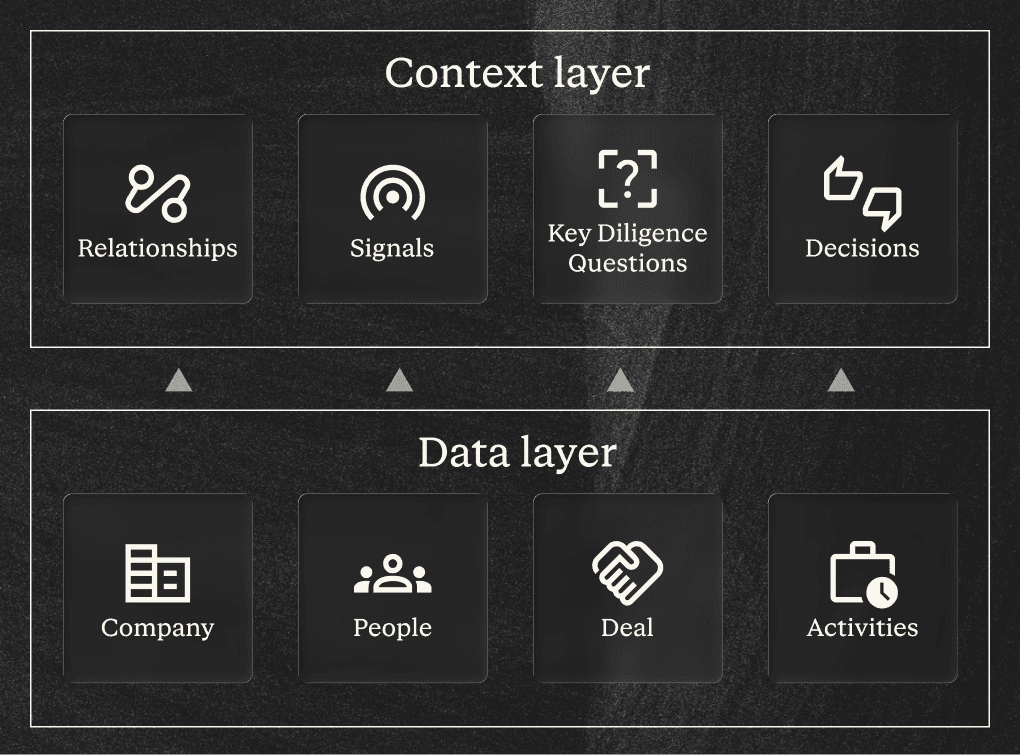
The Data Layer
Companies: Every target and portfolio co, connected to their full history.
People: Every contact and relationship, mapped with context.
Deals:Every opportunity, end-to-end.
Activities:Every touchpoint, linked to what matters.
The Context Layer where Entities are Connected
This is what separates a knowledge graph from any database or search tool. The context layer captures how your firm actually thinks, not just what it has seen.
Relationships: Who knows whom, through which deal, with what context.
Signals: The indicators of something has shifted and deserves attention.
Key Diligence Questions: The criteria and IC concerns applies to every deal.
Decisions: Why you passed/pursued, what the IC debated. All preserved and queryable.
How the Knowledge Graph Changes Conviction
Let’s replay the B2B Software deal story. With a knowledge graph, the pattern surfaces automatically: across your firm's last fifteen software deals, companies with this exact growth profile but founder-led sales motions underperformed at scale in the majority of cases. That's not a third-party benchmark. That's your firm's own history, applied at the moment of decision. The deal team's conviction shifts from "efficient growth story" to "scaling risk that needs to be underwritten," before the first IC meeting, not after the investment closes.
Now take the high-growth sector bet. The platform reveals that market growth alone has not been predictive of returns in your portfolio. Companies with weak pricing power underperformed regardless of tailwinds. The team stops chasing the market story and focuses diligence on the factors that actually predicted outcomes in your own deals.
This is what a knowledge graph makes possible: conviction built on what your firm has lived through, visible and available at the point of decision.
The Intelligence Platform Behind It
To make this concrete: the knowledge graph is the foundation layer, but it doesn't operate in isolation.
In our previous post, ‘ Why Institutional Knowledge Is the Most Undervalued Asset in PE‘, we described Level 2: Entity Intelligence as the layer that maps relationships across entities, and noted that it requires a knowledge graph architecture.
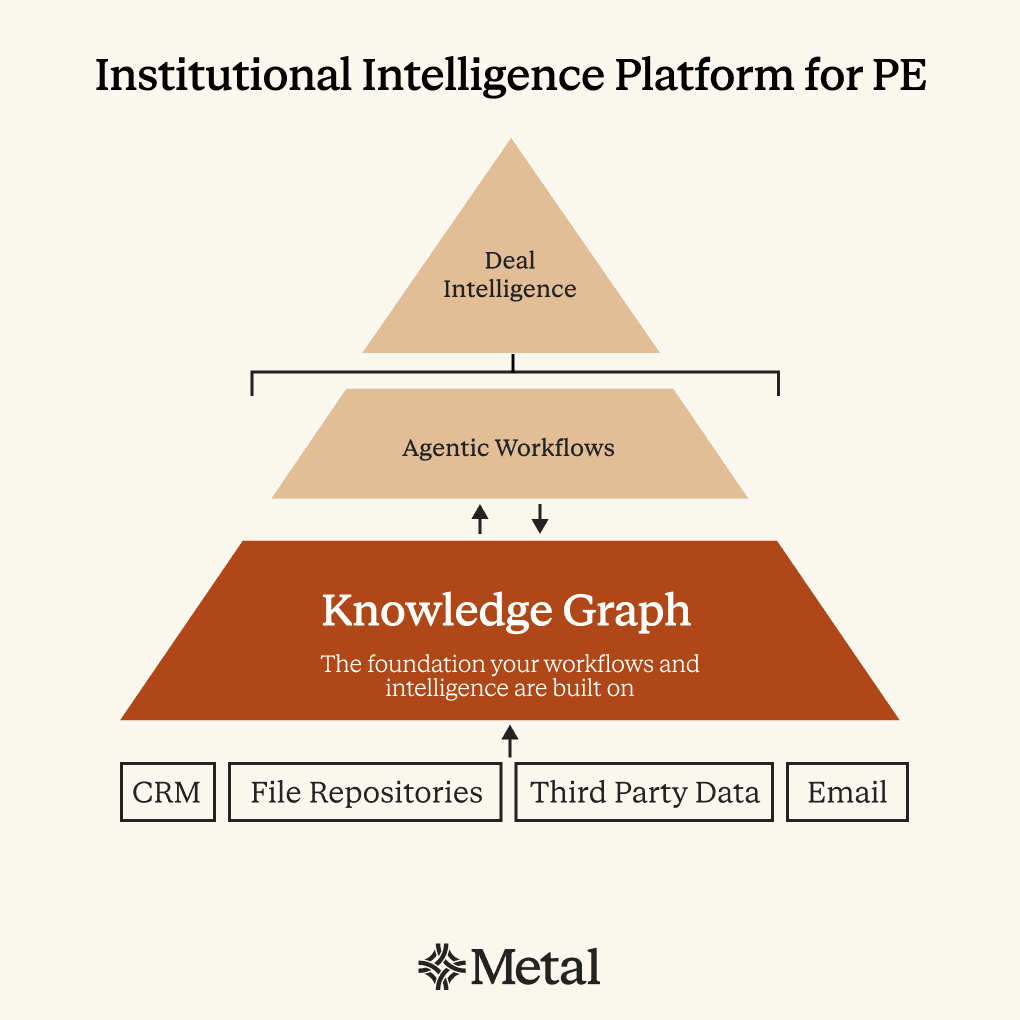
This is what that actually looks like in practice:
At the base, your firm's data flows into the knowledge graph, where it gets structured, connected, and enriched. This is the persistent layer that understands entities and relationships. Without it, you have documents. With it, you have institutional knowledge.
In the middle, agentic workflows operate on top of the knowledge graph. When a deal team runs an analysis, scores a CIM, or evaluates an expert call, the workflow pulls context from the full graph (not just a single file) and writes its outputs back.
At the top, deal intelligence pulls from both layers to accelerate conviction: the right relationships, signals, precedents, and analyses surfaced automatically, relative to where each deal sits in the lifecycle.
The key is what happens between these layers. The knowledge graph powers the workflows. The workflows enrich the graph. And every deal your firm evaluates makes the system smarter for the next one.
From Knowledge to Conviction
The real edge lives not in faster document processing but in activating the full depth of what your firm collectively knows.
The knowledge graph is the infrastructure that makes that possible. Fewer missed deals. Better and faster conviction. More deals won.
The firms that start building this layer today will compound their advantage with every deal, building conviction from a foundation no competitor can replicate. The firms that wait will keep relying on memory, disconnected systems, and judgment that walks out the door.
This is Part 2 of our series on institutional intelligence in Private Equity.
Read Part 1: Why Institutional Knowledge is Your Most Undervalued Asset
Read Part 3: Data Flywheel: How Knowledge Graph Compounds One Deal to The Next