Clearlake Capital and the Shift Toward AI-Native Investing

Taylor Lowe

Every private equity firm today has access to the same frontier models. The reasoning layer is no longer the moat. It's the floor. The question isn't whether a firm uses AI. It's what the firm is building underneath it.
That question is shaping how firms think about their AI strategy. Some firms are AI-assisted, applying models to existing processes to make familiar work faster. The deal flow, the diligence, the IC all look the same, with a faster engine attached.
Other firms are building toward AI-native: rethinking what the firm sees, how it reasons, and what it remembers, with infrastructure underneath the models that makes the firm's own intelligence compound.
Clearlake’s experience offers a useful lens into a broader shift underway across private equity. As firms move beyond experimenting with AI tools, a growing number are asking a different question: how can institutional knowledge itself become a scalable asset?
Clearlake's Architectural Bet
Clearlake is a leading global investment firm with more than $185 billion in assets under management across private equity, credit, and related strategies. Through Pathway Capital Management, a division of Clearlake, the firm offers a comprehensive markets platform spanning private equity, credit, secondaries, co-investments and infrastructure. Known for its operationally focused investment approach, Clearlake has long viewed technology, data, and AI as strategic enablers of value creation – both within its investment platform and across its portfolio companies.
Like many leading investment firms, Clearlake initially approached AI through internal experimentation. Over time, the firm reached a conclusion that many organizations are now arriving at: the long-term opportunity is not simply deploying models, but building the infrastructure that allows institutional knowledge, investment frameworks, and accumulated experience to become more accessible and reusable.
We sought a partner who understood our business and our ambition to differentiate through data. Building a scaled platform required specialized expertise, and we wanted to do it alongside a team whose core focus was turning data into a strategic advantage. The result was a true partnership that helped accelerate our vision.
— Tony La Rosa, Managing Director, Technology and O.P.S.®, Clearlake Capital
1) Scaling institutional judgment
One of the most significant opportunities AI creates for investment organizations is the ability to make institutional judgment more consistent and accessible. Firms develop pattern recognition over decades, but much of that knowledge traditionally resides in documents, conversations, and individual experiences.
At Clearlake, that has meant translating elements of the firm’s investment and value creation approach into structured frameworks that can be referenced and refined over time.
2) Making institutional memory actionable
When a new opportunity comes to market, every PE firm faces the same starting point. The information that matters often exists somewhere inside the firm. Getting to it takes time.
Firms are increasingly looking for ways to change that starting point.
Clearlake’s approach focuses on making relevant prior investment analysis, expertise, evaluations, operating insights, and adjacent learnings easier to access at the beginning of an investment process rather than after extensive searching.
Deal team can access their firm's context graph across multiple layers:
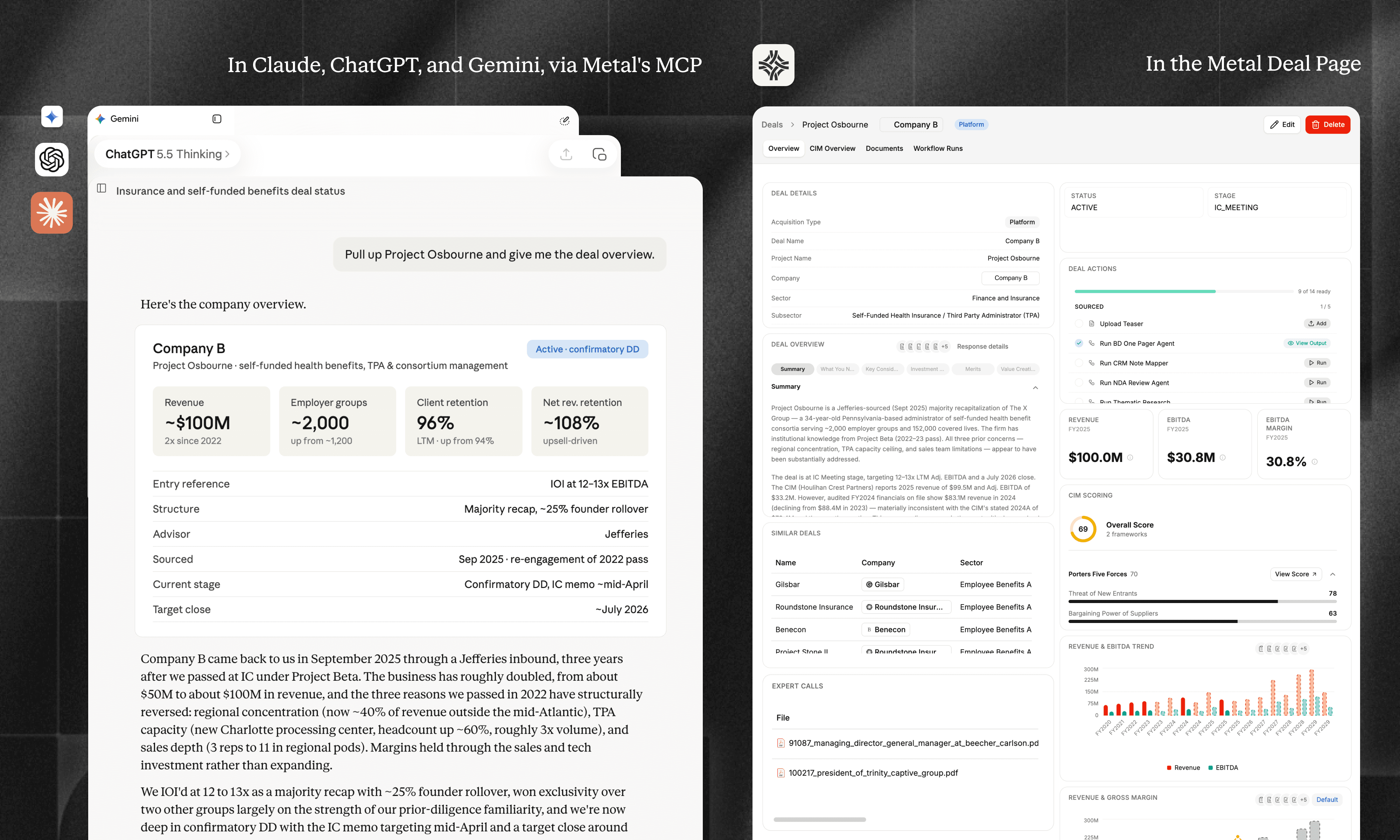
That asset compounds. The 10th opportunity in a sub-sector benefits from 9 prior looks, and the work the deal team starts isn't searching. It's deciding.
3) Conviction over orientation
IC can be the most consequential meeting at any private equity firm. It's where conviction gets tested, where dissent gets aired, and where capital gets committed. The quality of that meeting depends on what the committee can spend its time on.
The broader objective is not simply efficiency. It is creating more space for higher-value discussions and decision making.
At Clearlake, that means bringing together information, diligence, selective sector experience, historical context, and relevant insights into a more unified view.
4) Knowledge as a compounding asset
The most interesting aspect of AI-native investing may not be productivity gains. It may be the ability to compound organizational learning over time.
Clearlake’s deep investment and operating experience suggests that when knowledge is captured, structured, and made retrievable, each investment process can contribute to the next. The result is knowledge that grows more valuable as the organization gains experience.
What Doesn't Commoditize
Foundation models are the same for everyone. The reasoning layer is where capability gets distributed. It's not where advantage gets built.
A great model can read a CIM. It can produce a clean analysis on any deal in any sector. What it cannot do is know what a specific firm has seen before. It cannot tell a deal team that the firm looked at this exact sub-sector eighteen months ago, or that a comparable business model in the portfolio grew EBITDA 40% with a specific operational playbook. That context isn't in the model. It can only be built by the firm.
This is increasingly where firms are focusing their efforts. While foundation models continue to improve and become more widely available, institutional knowledge remains unique to each organization.
Clearlake’s approach reflects a broader belief that durable advantage will come less from access to AI itself and more from how firms capture, structure, and apply their own accumulated experience.
We believe that in five years, the firms that started building this asset in 2026 will be operating in a different category. We chose to be one of them.
— Tony La Rosa, Managing Director, Technology and O.P.S.®, Clearlake Capital
The firms making this choice now are accumulating a year of compounding that their competitors may not be able to replicate. The gap that opens up isn't a tooling gap. It's a knowledge gap. And knowledge gaps don't close by buying software.
The Firms Defining What's Next
The private equity industry appears to be approaching a fork in the road.
One path uses AI primarily to accelerate existing workflows. The other uses AI to make institutional knowledge more scalable, accessible, and durable.
Clearlake’s experience suggests that the distinction matters. While models may become more increasingly commoditized, the knowledge, judgement, and experience accumulated within a firm remain unique.
The firms that successfully combine those assets with AL may not simply work faster. They may develop institutional intelligence that compounds over time, creating advantages that become meaningful with every investment, every operating initiative, and every decision.
In that sense, the question is no longer whether AI will reshape private equity. The question is which firms will use it to build something that lasts.