The Data Flywheel in Private Equity

Taylor Lowe
Two analysts at the same firm are evaluating companies in the same sector. Both using AI. Both getting good outputs. But they're working in silos — building separate context, surfacing separate insights. When both projects wrap, their work gets shared the way it always has: over email, Teams, or in a meeting.
The AI worked. But the firm didn’t get smarter.
This is the gap that most AI tools, even the most advanced ones, don't close. They maintain context within a project, iterate on documents, and produce strong analysis. But the context is individual, not institutional.
AI output typically stays where it was created: in one person's workspace, in one conversation, for one deal. One analyst's insight never becomes another team's starting point. One deal's diligence never informs the next. The firm's collective intelligence doesn't compound.
What is Data Flywheel?
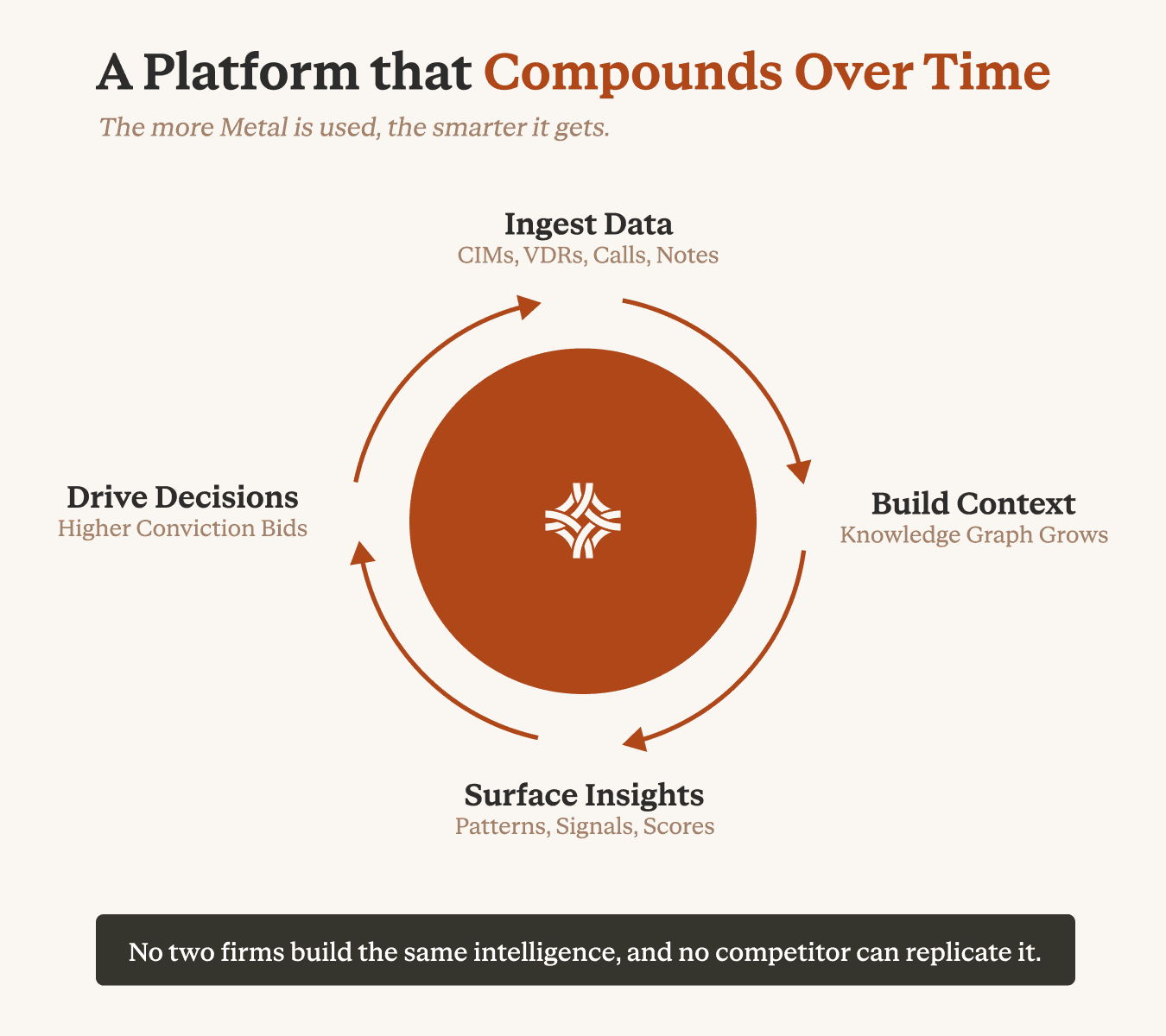
A data flywheel is what happens when every output flows back into the knowledge graph as structured, connected data. The CIM scoring from a deal becomes the signal for the next one. The expert call analysis enriches the company profile. The IC decision and its reasoning gets captured and linked to the sector, deal type, and people involved.
The difference isn't whether your AI produces good work. It's whether that work makes the next piece of work better, for every team, across every deal, over time.
How One Deal Makes the Next One Better
Eighteen months ago, the firm took a hard look at a B2B software company operating in the healthcare data space. Thorough diligence: market sizing, customer calls, competitive landscape. They passed, mostly on valuation, but the work was done.
Now a new company in the same space, AcmeCo, comes in through a banker. The associate opens Metal to start the CIM review. Before the associate has read a page of the CIM, the prior diligence is already surfaced. The market map the team built, the customer concerns that came up in expert calls, the specific reason the firm passed on the last one.
They're not starting from scratch. They're starting from a thesis the firm already stress-tested.
The CIM review isn't evaluating AcmeCo in isolation. It's being read against a prior view of the market. The firm already knows which expert profiles are worth sourcing and what angles produced signal last time, so that process starts sharper too.
By the time the team is prepping for the management meeting, they have a point of view that would normally take months to develop. When a partner asks in IC why they have conviction on the market, the answer isn't "we did the work on this deal." It's "we've been building a view on this space for a year and a half."
That's what knowledge compounding looks like across deals, not just within them.
From Individual to Institutional
This is the shift that matters. Most AI tools today make individuals more productive. That's valuable, but it doesn't compound.
A data flywheel operates at the firm level. Every workflow run by any team member enriches the same knowledge graph. The associate scoring CIMs in New York and the partner evaluating a platform in London are both pulling from and contributing to the same institutional layer. Insights don't stay in personal chat histories or individual folders. They become firm-wide knowledge, accessible to anyone, at any stage, across any deal.
The more your firm uses it, the smarter it gets. Not for one person. For everyone.
The Compounding Edge
This is what separates a tool from infrastructure. A tool helps you do today's work faster. Infrastructure changes how tomorrow's work gets done.
A firm that has been running its deal flow through a data flywheel for two years has a fundamentally different starting point than one that hasn't. Every deal evaluated, every pattern surfaced, every decision captured has made the system richer.
And unlike the AI models themselves, which every firm can access, the data flywheel is built from your firm's proprietary history. No competitor can replicate it. No vendor can sell it. It's yours.
This is Part 3 of our series on institutional intelligence in Private Equity.
Read Part 1: Why institutional knowledge is your most undervalued asset
Read Part 2: Break down the knowledge graph