Why Metal's MCP Isn't a Connector: It's Your Context Layer

James O'Dwyer

By now you have heard about MCP (Model Context Protocol) more times than you can count, and you may already have a few running. An MCP is a pipe. Anyone can build one, and by now almost everyone has. But a pipe creates value only when there is something worth flowing through it. The data is what matters, and an MCP is only as valuable as the data it actually unlocks.
You Already Have MCPs. Here's Where They Break.
Say you connect a SharePoint MCP to your Claude. It can reach your files and hand the LLM a folder tree, but it has no concept of a company, a deal, or the sub-sectors your firm actually cares about. Ask it "show me the last 50 deals we did in industrials," and your AI needs to figure out what a “deal” is, burns tokens deciphering the question, then returns a partial, inaccurate, or expensive answer. That is what flows through a raw pipe: raw, fragmented data.
This is why generic MCPs feel underwhelming at firm scale. On a single document they are fine. The moment a question spans your whole firm, the last 50 deals, every comparable, the risks you've seen before, the model tips over, because there's no structure underneath for it to reason across.
Why Metal MCP: Your Firm’s Context Layer
The data scattered your CRM, your data room, emails, and every other source is messy, fragmented, and full of duplicates.
Metal takes that raw input and cleanses, resolves, and unifies it into one structured context layer —your firm's Context Graph.
How?
Metal models firm history as interconnected data points in the graph, not isolated documents. Companies, documents, deals, people, expert calls, screenings, discussion threads: these are first-class data types with relationships connecting them.
Data doesn't have one fixed meaning. The same source can be relevant in completely different ways depending on what you're trying to find.
When an analyst types "Acme," Metal runs a name-matching search to locate the relevant data. When they ask "find companies like Acme," the system uses a different representation of the same data, one tuned for business similarity rather than name matching. These aren't different queries against the same index. They're fundamentally different retrieval operations that happen to involve the same piece of information.
When results come back, they don't arrive as a flat list of text. Every result carries its data type: this is a Deal, this is a Person, this is an Activity, this is a Document excerpt. The AI knows what kind of thing each piece of context represents, which lets it reason across data types rather than treating everything as undifferentiated text.
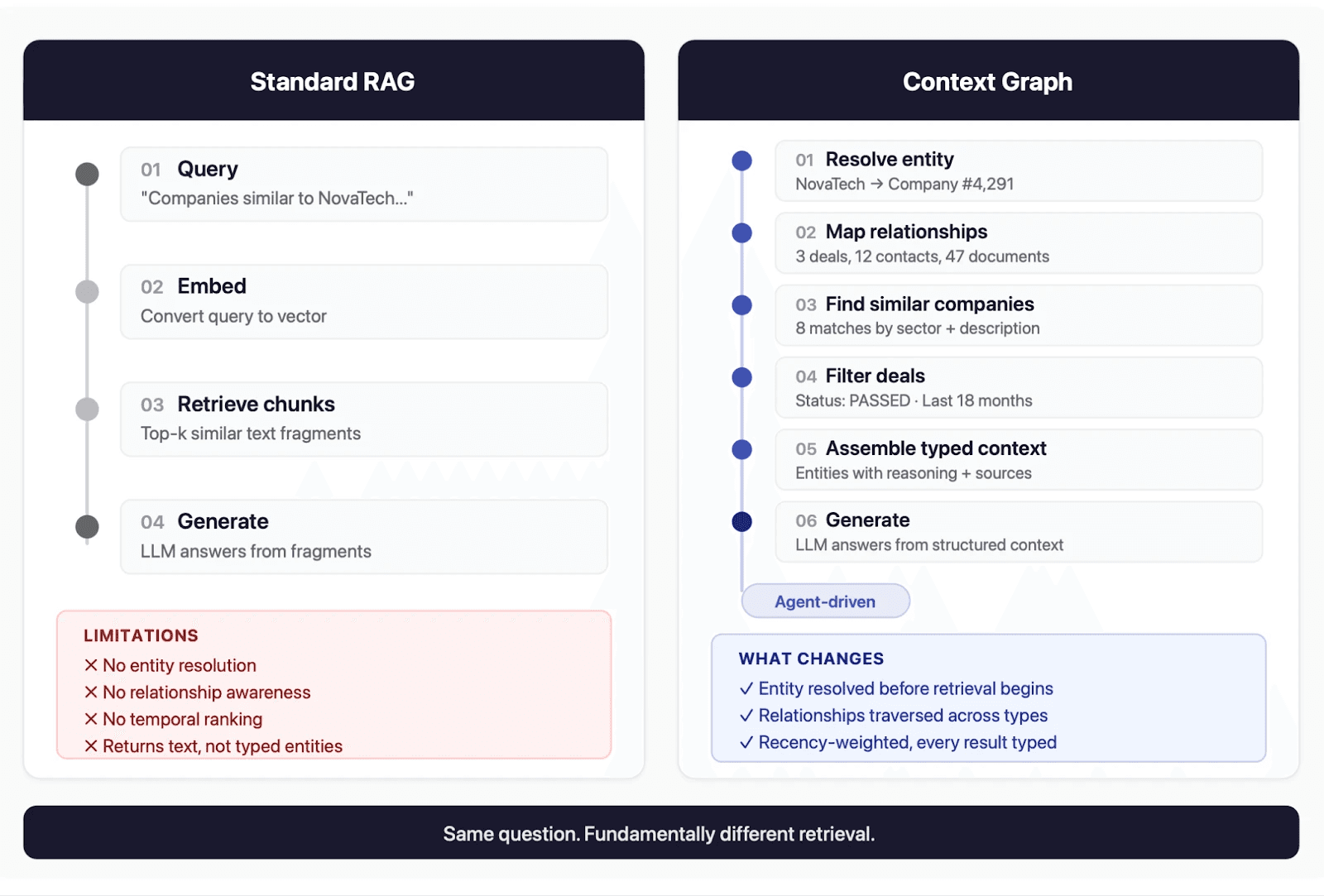
So when you ask "show me the last 50 deals we did in industrials," the answer is already structured. Your LLM knows what a deal is, which sub-sectors you track, where every figure came from, and which targets score highest against your firm's own scoring framework because Metal resolved and structured all of that before you asked.
You get an accurate, source-traced answer across the whole firm, not a guess assembled from a folder tree.
What Your LLM Can Do Once Connected
The capabilities map to Metal's three layers. The complete tool list is in the tools reference; here is what they unlock.
Read your firm's structured context. Search and retrieve companies, people, deals, documents, lists, and activities from a resolved, deduplicated, permission-aware graph, with every fact traced back to its source document and page.
See the judgment behind the data. Pull screenings, scores, and scoring frameworks, so the assistant knows not just that a deal exists, but how your firm evaluated it and against which criteria.
Act on the graph. Inspect, run, and review workflows, and with the right permissions, help build or edit them. The LLMs runs your firm's own deal work and writes results back into the graph, where the next question can use them.
Metal MCP in Action
Note: All data shown in these examples are fictional and used solely to demonstrate Metal MCP's capabilities. They do not represent real companies, deals, or firm data.
For the full 4K version, click the YouTube button below.
Why This Compounds
Same model, better answers, because the ceiling isn't the model, it's the data underneath it. Point a generic LLM at raw files and you get fast retrieval and shaky answers. Connect it to a structured graph of your firm's decisions and you get conviction: answers that hold across 20-plus deals, trace to source, and carry what your firm already decided. And because every workflow reads from and writes back to the graph, every deal makes the next one sharper. That compounding is the part a competitor cannot copy, because it is built from your firm’s unique history.
How It Works and How to Start
Your admin enables MCP for the organization, and each user connects their AI tool once through OAuth. Access is scoped to the signed-in user and organization and respects your existing Metal permissions. Metal never trains on your data. If you are evaluating Metal, the best test is not a demo on sample data, it is your own: bring in one live deal or one sector and see what your assistant can do once it knows your firm. Start with the Metal MCP overview.
Frequently Asked Questions
Aren't all MCPs basically the same?
No. An MCP is a transport standard, a pipe between an AI tool and a data source. Its usefulness depends entirely on what flows through it. A generic MCP passes raw, unstructured files. Metal MCP passes a resolved context graph of your firm's deals, companies, people, and decisions, which is what lets an AI reason across your whole firm.
My SharePoint/ Salesforce/ PitchBook already has an MCP. Why do I need Metal?
No single generic MCP has the full picture. SharePoint holds the documents but has no concept of a deal. Your CRM understands deals but not the insights trapped in those documents. PitchBook knows the market, not your firm's own decisions. Each one answers a firm-wide question through its own blind spot. Metal unifies all of these sources into one structured context layer, so the answer is complete and traceable across the firm.
What is Metal MCP?
Metal MCP is a secure remote Model Context Protocol server that lets LLMs, or your AI assistants, like Claude, ChatGPT, and Copilot work with your firm's context layer: companies, deals, people, documents, activities, screenings, scores, and workflows. Access uses OAuth and respects your existing Metal permissions.
Can Metal MCP run and build workflows, or only read data?
Both. It can search and retrieve your firm's data, run existing workflows and review human-in-the-loop steps, and with the right permissions, help build or edit draft workflows. Available tools depend on the user's granted scopes and organization settings.
Get Started
If your firm already uses Metal, ask your admin to enable MCP, then connect your AI tool through OAuth. If you are evaluating Metal, the best test is not a demo on sample data, it is your own: bring in one live deal or one sector, and see what your assistant can do once it knows your firm. Start Today