From Knowledge to Conviction at the Point of Decision

Taylor Lowe

In the first three parts of this series, we laid the foundation: institutional knowledge is PE's most undervalued asset. A knowledge graph structures it. A data flywheel compounds it.
But there's a final question: how does all of that intelligence actually reach the people making decisions?
The Visibility Problem
A managing partner sits down for Monday's pipeline review. The firm has a couple of deals in confirmatory diligence, a few where the team is preparing IOI bids, and a handful of new opportunities that came in from bankers last week. She wants to make sure the team is spending the right time on the right deals.
What she actually gets: a CRM that doesn't capture the full picture, a pipeline tracker pulled together last Friday, and a Monday morning conversation where the real context finally comes out:
The banker on Project Atlas hinted the process is accelerating.
This new healthcare services deal looks a lot like one the firm passed on a year ago.
But none of this came from a system. It came from whoever happened to be in the room.
The connections that drive conviction get built through workstreams and conversations, but nothing captures them in a way that's visible and actionable across the deal lifecycle.
Introducing Deal Intelligence
In the previous blogs, we described two foundational layers : the knowledge graph that connects your firm's data by meaning, and the data flywheel that compounds it with every workflow.
Together, they generate a growing body of structured knowledge: deal scores, risk flags, sector signals, relationship maps, and pattern recognition across your portfolio. But structured knowledge alone doesn't drive decisions. It needs to be organized around how deal teams actually work: stage by stage, from sourcing through exit.
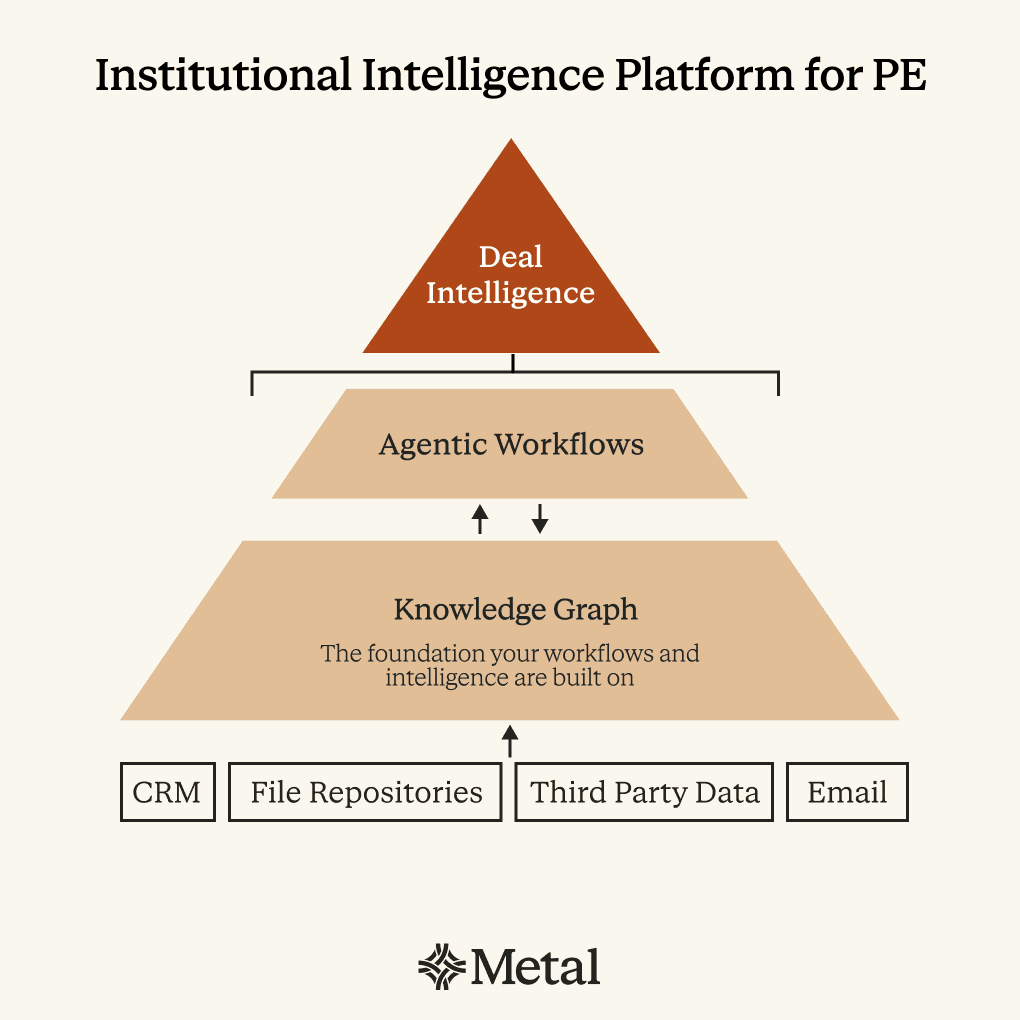
That's what deal intelligence is. The knowledge graph provides the infrastructure. Workflows run on top of it, reading from and writing back to the graph with every action. And deal intelligence is the layer that ties it all together, organizing everything around the deal lifecycle and surfacing it to the right person at the right stage.
No single layer does this alone. Without the knowledge graph, there's nothing to surface. Without workflows, the knowledge doesn't compound. And without the deal lifecycle as the organizing principle, intelligence never reaches the people making decisions in the context they need it.
From Individual Desks to Firm-Wide Conviction
When every deal team's work feeds the same system, the decision-making dynamic across the firm changes. The associate in New York and the partner in London are looking at the same picture, informed by the same knowledge, updated in real time. Information doesn't need to be manually shared, forwarded, or presented in a meeting to travel across the firm.
This is more than transparency. It's a structural upgrade to how conviction gets built. Instead of conviction living in one deal team's head until they present it at IC, it's visible, evolving, and informed by everything the firm collectively knows.
When Deal Intelligence Meets Deal Team
Now bring back the managing partner from the Monday pipeline review, but this time, deal intelligence is in the room before she is.
She opens the firm's pipeline view. Every active deal, its current stage, the latest risk flags, and what's changed since last conversation, all updated in real time as workflows run and new intelligence flows in.
She scans the new opportunities. One is immediately flagged:
The firm evaluated a similar business in the same sector two years ago.
The IC concern then was management's ability to scale past $50M in revenue.
The new target has nearly the same business model.
Her question shifts from "is this worth looking at" to "has the structural concern from last time been addressed."
She turns to one of the deals in confirmatory diligence. The system has surfaced a connection she wouldn't have thought to look for: a portfolio company in an adjacent space whose operating data directly validates this deal's core growth assumption. That's not something the deal team found through research. It's a cross-deal connection the knowledge graph made because both deals live in the same system.
None of this required her to ask the right question first. The system surfaced what she didn't know she needed to see.
This is the difference between asking a question and being shown what you never thought to ask. The first is search. The second is intelligence.
What’s Next: Deal Intelligence, Live
We're currently testing this experience with a small group of firms. A unified view of the deal lifecycle, built on the knowledge graph, where every workflow and every prior deal informs what the team sees next. If this is the kind of visibility your firm has been missing, we'd love to show you where it's heading.
The Full Picture: Why This Completes the Conviction Equation
In Part 1 of this series, we talked about four constraints on conviction: Data, Time, Perspective, and Iteration.
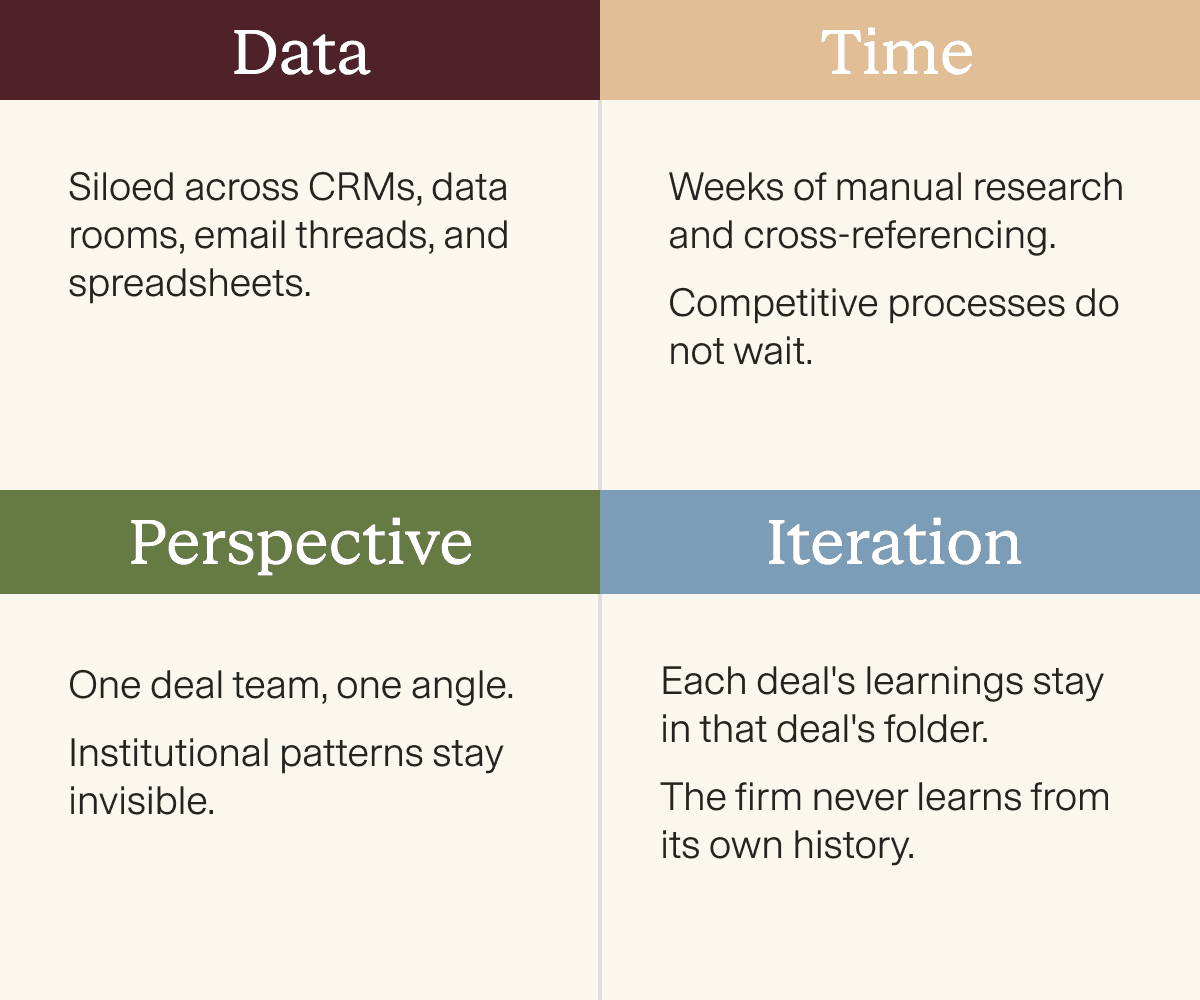
The knowledge graph expands Data by connecting everything your firm knows. The agentic workflows compress Time by ensuring no one starts from scratch. Deal intelligence unlocks the final two.
Perspective:Your deal team sees every deal against the full context of the firm's history, patterns, and prior decisions. The questions they ask are sharper because the system surfaces what they didn't know to look for.
Iteration: the feedback loop between deals tightens. Every decision, outcome, lesson learned is captured and surfaced for the next evaluation.
When all four constraints are addressed, conviction compounds. And firms that have compound conviction win more deals.
This is Part 4 of our series on institutional intelligence in PE.
Read Part 1: Why institutional knowledge is your most undervalued asset
Read Part 2: Break Down the Infrastructure: Knowledge Graph
Read Part 3: The Data Flywheel in Private Equity