Metal Workflows Overview

James O'Dwyer
Metal's deal intelligence platform is built on three layers:
The knowledge graph structures your firm's proprietary data, mapping the relationships between deals, companies, people, and decisions. Workflows run on top of that graph, reading from and writing back to it with every action. And deal intelligence is what emerges when both compound across the full deal lifecycle, surfacing what your team needs at the point of decision.
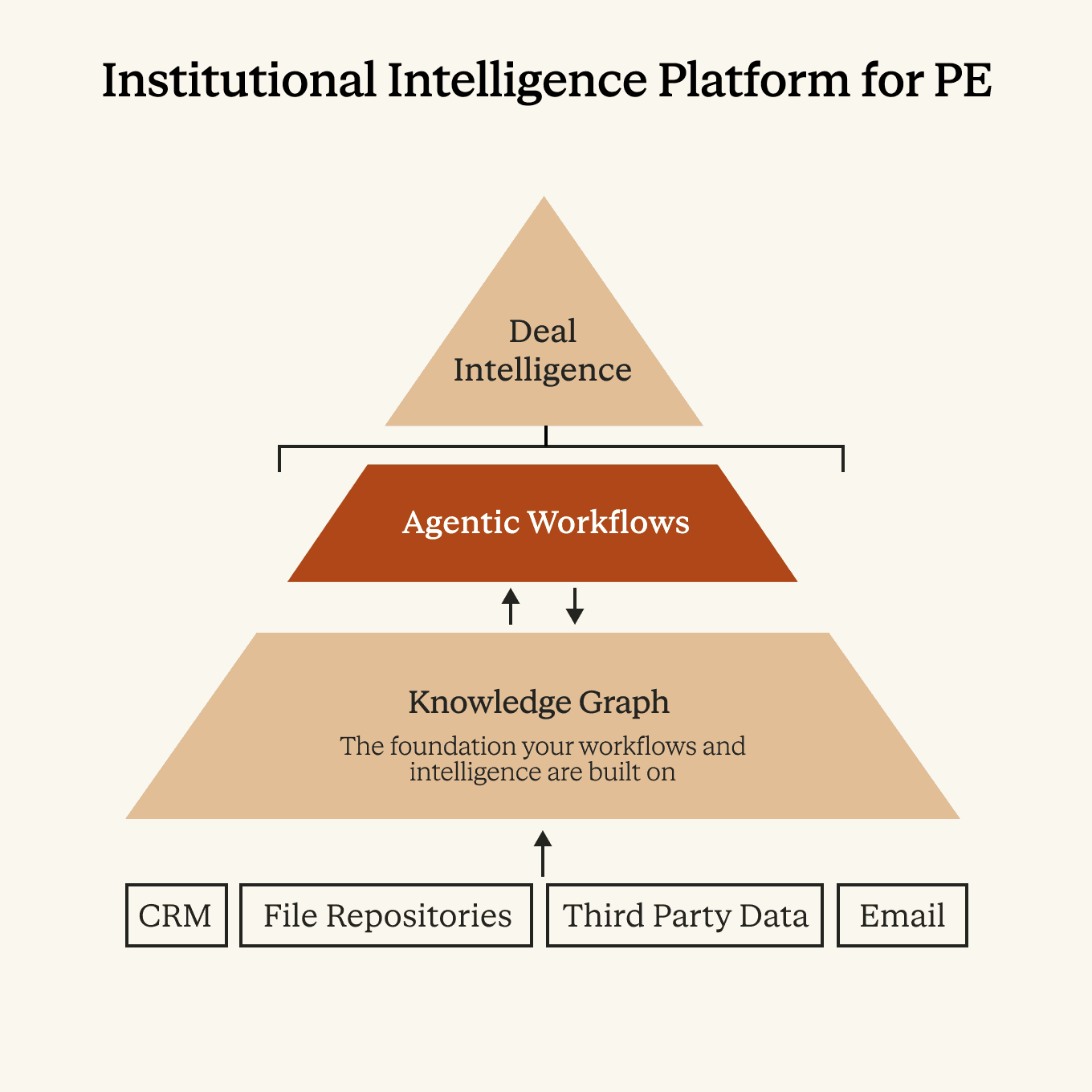
Workflows are the connective layer. They're how the knowledge graph turns from a structured asset into a working system, one where a CIM scored today informs how your firm evaluates the next opportunity in the same sector, and an expert call analyzed during diligence surfaces again when a comparable deal enters the pipeline a year later.
This is what separates Metal from standalone AI tools. Point solutions automate isolated tasks. Metal Workflows operate across the deal lifecycle, connected to everything your firm has learned.
Metal has built dozens of purpose-built AI workflows spanning the deal lifecycle.
How Metal Workflows Are Organized
Metal Workflows are organized around the stages of the private equity deal lifecycle. Each workflow is tagged by stage, input type, and function, so deal teams can filter and access the right workflow in seconds. Users can also favorite their most critical workflows for one-click access during active deals.
Below is the full list of available workflows.
Sourcing
The sourcing stage is where deal teams identify sectors of interest, build target lists, and initiate outreach. Metal's sourcing workflows connect to your knowledge graph so that every new search starts from what your firm already knows about a sector, a company, or a relationship.
Identify Attractive Sectors: Identifies target sectors within a specific vertical that align with PE growth opportunities. Uses firm-wide deal history and market data to surface sectors where the firm has existing conviction or pattern recognition.
Thematic Research: Conducts sector-level research for the purpose of sourcing targets. Synthesizes public data, prior deal context, and firm expertise into a structured thesis that can be shared across the team.
Target Company Sourcing: Identifies and scores the top PE acquisition targets within a defined geography and vertical, benchmarked against the firm's investment criteria and historical deal profile.
CEO Outreach Email Drafts: Filters a target list to companies scoring above a defined threshold, then drafts personalized CEO outreach emails based on company-specific insights.
BD One Pager Agent: Generates a quick-reference business development one-pager on any company for conference prep, meeting prep, or initial screening.
CRM Note Mapper: Ingests meeting notes and automatically creates or updates records in Salesforce, ensuring that relationship data captured in conversations flows back into the firm's CRM without manual entry.
Screening and Evaluation
Once opportunities enter the pipeline, screening workflows help deal teams evaluate fit quickly and consistently. These workflows score, summarize, and assess incoming materials against the firm's historical benchmarks and investment criteria.
CIM Scoring: Scores and evaluates received CIMs with automated analysis. Outputs are structured and queryable, building a firmwide library of scored opportunities that can be referenced across future deals.
CIM Write-Up: Generates a structured write-up for each CIM, summarizing the business, financial profile, and key considerations in a format consistent with the firm's internal standards.
Initial Company Screening: Evaluates a private company's suitability for PE ownership and produces a structured briefing with recommendations. Designed for rapid first-pass assessment at scale.
Firm Opportunity Review: Produces a standardized, firm-wide analysis of an opportunity for partner-level triaging and assessment. Ensures every deal is evaluated through the same lens, regardless of which team sources it.
NDA Review Agent: Reviews and marks up NDAs, flagging non-standard terms and accelerating the legal review process so deal teams can move into diligence faster.
Due Diligence
Diligence workflows are where the knowledge graph delivers the most value. Every workflow in this stage pulls from the firm's accumulated deal history, expert call transcripts, portfolio data, and prior IC discussions to inform the current evaluation.
Benchmarking Agent: Benchmarks a target company against comparable peers in its sector using financial data, knowledge graph relationships, and expert call insights. Surfaces how the target compares to companies the firm has already evaluated or owned.
Expert Call Analysis: Analyzes expert call transcripts and generates structured insights. Findings are stored in the knowledge graph and linked to the relevant company, sector, and deal, making them searchable across future evaluations.
VDR First-Pass Analysis: Reads all documents in a virtual data room folder and produces a proactive first-pass analysis including document inventory, key financial findings, and flagged risks.
VDR Review: Comprehensive virtual data room analysis for in-depth diligence. Extracts and synthesizes key findings across legal, financial, and operational documents.
Target Risk Assessment: Assesses a specific target's potential risks and mitigants, structured around the dimensions that matter most to the firm's investment committee.
Portfolio Synergy Assessment: Analyzes a target company against the firm's current portfolio to surface revenue synergies, operational overlap, geographic adjacencies, and cross-portfolio value creation opportunities.
Value Creation Diagnosis: Ingests a CIM and benchmarks KPIs against the firm's internal deal history and external sources, mapping performance gaps and identifying the highest-potential value creation levers.
IC Memo Creation (PPTX): Generates a comprehensive investment committee memo covering company overview, investment thesis, risk assessment, and value creation plan. Output is formatted as a presentation ready for IC review.
GP Diligence Agent: Produces a comprehensive diligence report on a GP stakes target, analyzing fund strategy, track record, team composition, portfolio construction, and performance attribution.
Underlying Asset Parser: Parses and structures underlying asset data from complex investment vehicles, making it queryable for portfolio analysis and reporting.
Portfolio Value Creation and Exit
After close, portfolio workflows help deal teams monitor performance, prepare for board meetings, track competitive dynamics, and assess exit readiness. The revenue bridge analyses transform raw financial data into structured insights that inform both value creation execution and exit timing.
Portfolio Monitoring: Ongoing monitoring of portfolio company KPIs, market signals, and operational performance. Configured to each firm's reporting cadence and investment thesis.
Board Meeting Prep: Synthesizes quarterly board materials, value creation updates, and market context into a strategic board meeting brief for portfolio company board participation.
Competitor News and Positioning Analysis: Analyzes a portfolio company against its key competitors using recent news, M&A activity, and market signals to surface competitive risks and strategic positioning opportunities.
Exit Readiness Assessment: Comprehensive exit evaluation covering financial positioning, market timing, buyer landscape, and readiness across operational and strategic dimensions.
3 Year Customer Revenue Bridge: Transforms customer revenue data into a 3-year revenue bridge report showing how revenue has changed by customer, with breakdowns by growth, churn, and expansion.
3 Year Product Revenue Bridge: Generates a 3-year revenue bridge by product line with year-over-year breakdowns, summary trends, and product-level performance analysis.
3 Year Region Revenue Bridge: Produces a 3-year revenue bridge by customer, region, and industry with region-level breakdowns for geographic performance analysis.
3 Year Segment Revenue Bridge: Creates a 3-year revenue bridge by customer, product family, segment, and sub-product for granular business unit performance analysis.
Investor Relations and Compliance
IR and compliance workflows reduce the operational burden of LP reporting and questionnaire management. Historical DDQ responses are stored in the knowledge graph, building a firmwide answer library that improves with every questionnaire completed.
DDQ Auto-Population: Parses an incoming LP DDQ, matches each question against the firm's historical DDQ library and supporting documents, and auto-populates responses for review.
DDQ Solver: Automatically answers due diligence questionnaires using the firm's own documents and prior responses. Cuts DDQ response time from days to hours.
LP Pre-Meeting Notes: Generates a prep document for LP meetings, synthesizing fund performance, recent activity, and relationship history into a ready-to-use briefing.
Pipeline Automation
Pipeline automation workflows run in the background, ensuring that new deals are captured and organized in real time as they enter the system.
Active Pipeline: Automatically adds new deals to the active pipeline when created, eliminating manual pipeline management overhead.
Healthcare: Sector-specific pipeline trigger for healthcare deals, ensuring new opportunities are tagged and routed to the right team immediately.
Built for Your Firm, Not for Generic Use Cases
The workflows listed above represent Metal's current library, and new workflows ship monthly based on what firms need in live deal execution.
Because every workflow runs on the knowledge graph, outputs don't disappear into a folder. They become part of the firm's compounding intelligence.
Metal is the deal intelligence platform for private equity. Workflows are how intelligence meets execution across the deal lifecycle.
To see Metal Workflows in action, book a demo.