Chat-Authored Dashboards: Turn Deal Questions Into Live Operating Views

James O'Dwyer
What is the Metal Dashboard, and how does it help private capital deal teams?
Metal's chat-authored dashboards are real-time, interactive operating views built for private capital teams to create, refine, and manage deal pipeline and LP analytics directly in chat.
A question becomes a reusable operating view that stays connected to the work as the underlying data changes.
That matters because the value of a dashboard is not the chart. It is whether the whole team has a single source of truth current enough for the whole team to rely on.
Which private equity and private credit teams use live dashboards, and why?
Business development and deal sourcing teams: A live coverage and pipeline dashboard tracking intermediary relationships, sourcing gaps, and CRM records. Rebuilt in a spreadsheet, it is stale before the next sourcing meeting.
Deal teams: A live deal dashboard tracking deal status, owners, VDR activity, and open diligence questions across active transactions. When decoupled from your firm's Context Graph, it stops matching the actual deal state.
Investor relations and capital formation teams: A fund and LP dashboard covering commitments, fundraising pipelines, and LP activity. Reconstructed manually before every LP call, it relies on memory and static exports.
Portfolio monitoring teams: A portfolio KPI dashboard tracking financial metrics and operating performance across portfolio companies and funds. Assembled by hand, it lags the operating reality it is meant to show.
Firm leadership and the Investment Committee (IC): One shared operating view of the firm's deal intelligence, current enough to decide from.
How do chat-authored dashboards work?
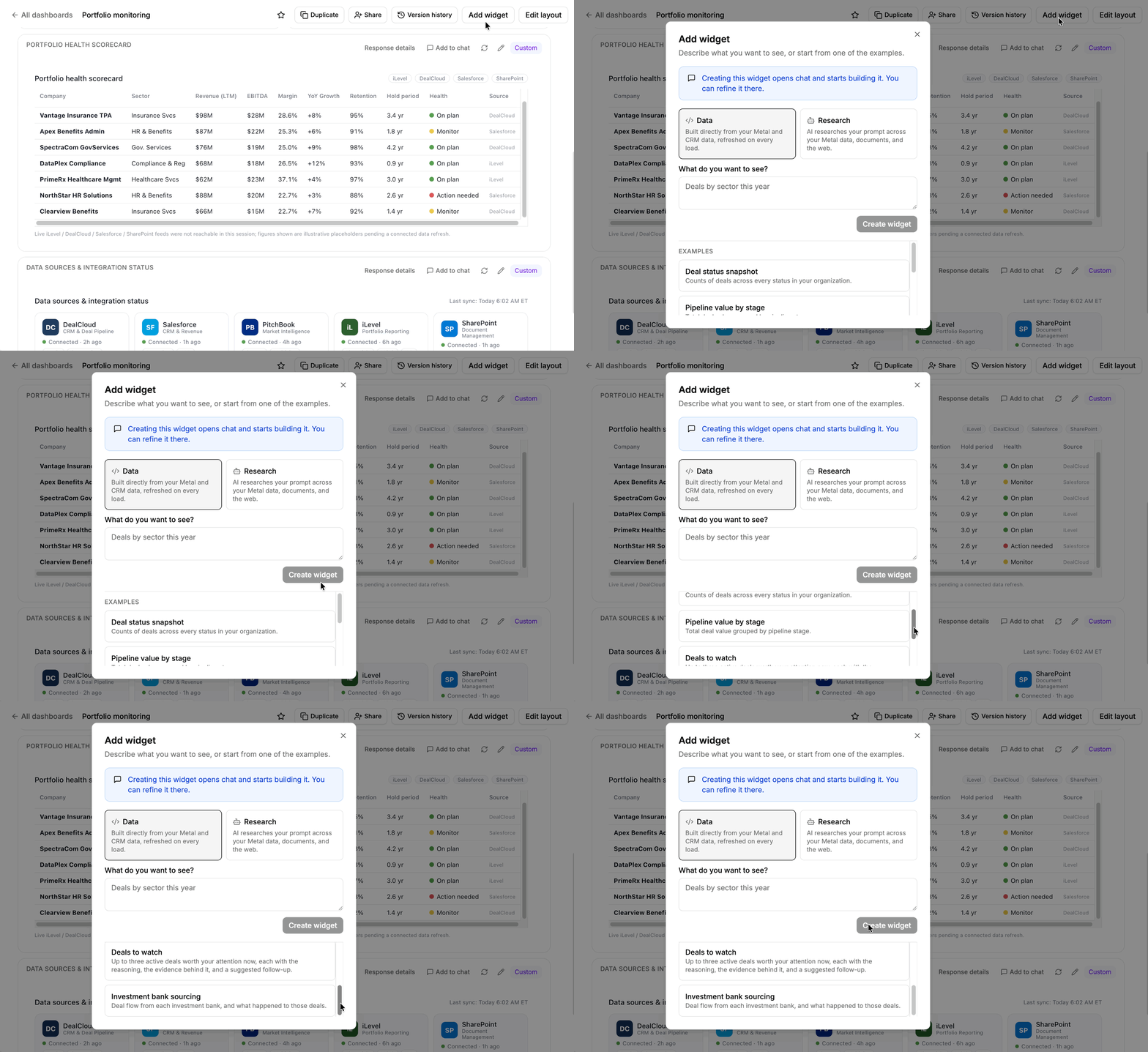
You describe the view you want in chat. Metal builds it as live widgets on the Context Graph, reading from the same connected company, deal, and activity records used everywhere else in the platform. You refine the view in chat, or take manual control to add and arrange widgets yourself, and every widget stays tied to the firm's context rather than a one-time export.
The distinction is architectural. A dashboard in Metal is an access surface on the context layer. If the context is connected, the view built on it is connected too. This aligns directly with BCG's strategy for enterprise agentic AI, which emphasizes that effective AI orchestration requires building workflows around an underlying knowledge graph rather than isolated prompt surfaces.
What can you do with chat-authored dashboards?
Can you build a dashboard from a single question?
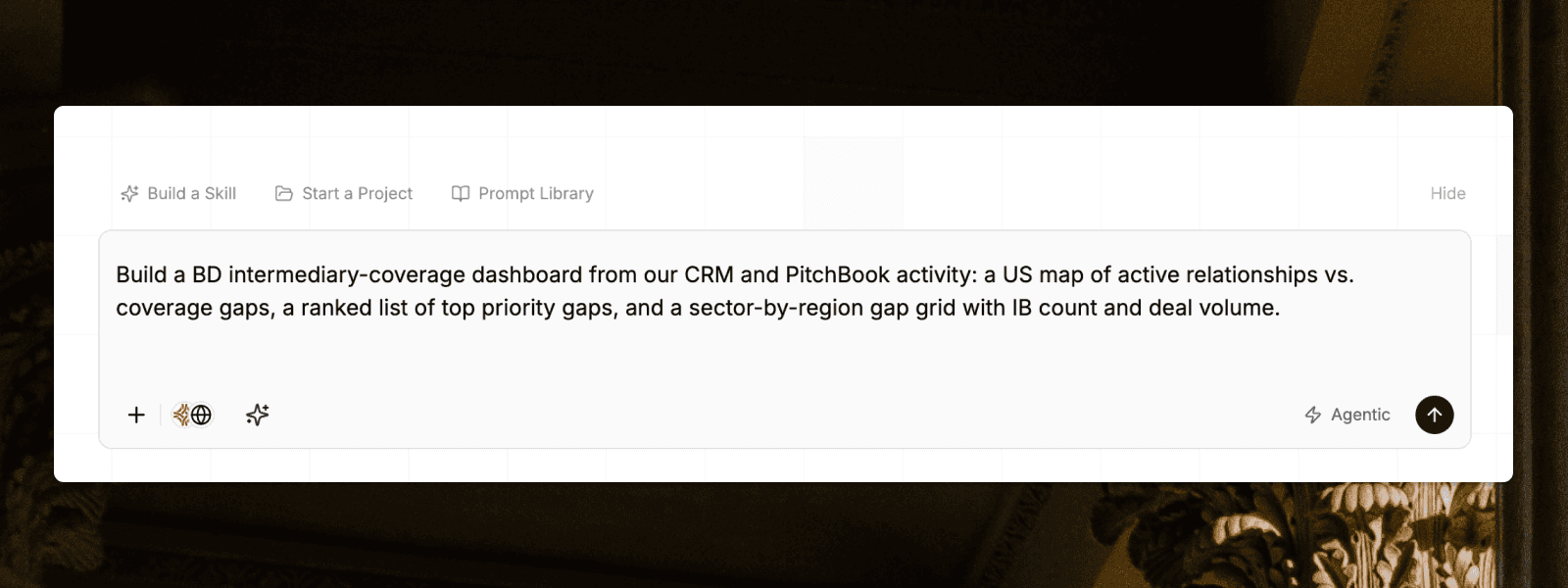
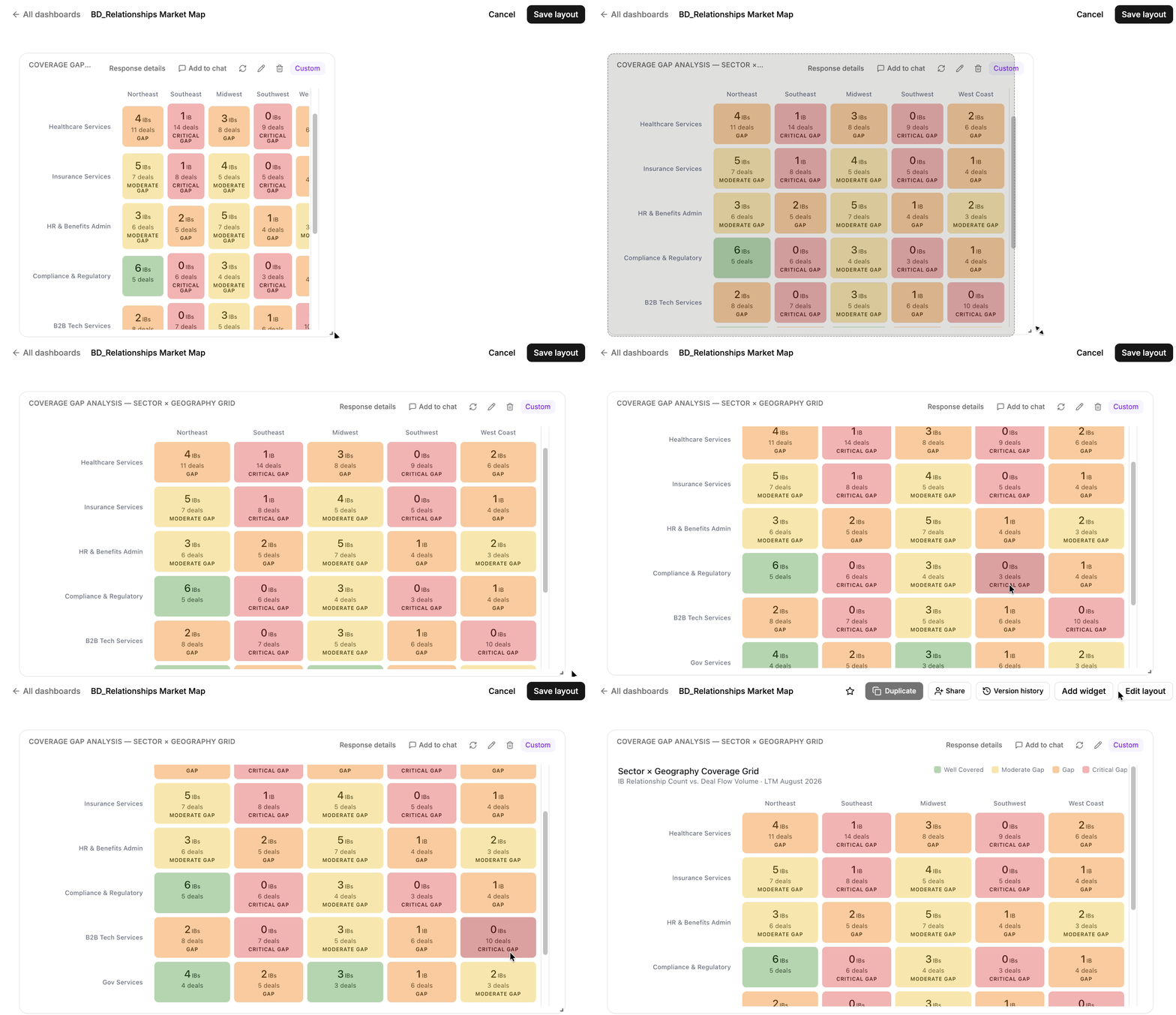
Yes. You describe the view in plain language, for example a coverage map of your intermediary relationships or a fund and LP overview, and Metal assembles it as live widgets. A data question becomes a reusable list, chart, or map instead of a static answer you have to rebuild later.
Can you refine a dashboard in chat after it is built?
Yes. You can change any widget by asking, for example filtering to one sector, ranking gaps by deal volume, or narrowing to a region, and the view updates in place. The dashboard is a living view you keep shaping, not a fixed report you regenerate from scratch.

Can you edit or arrange widgets manually?
Yes. Alongside authoring in chat, you can add and edit widgets directly when you want control over layout and composition. Chat authoring and manual control work on the same dashboard, so a team can move between describing a view and adjusting it by hand.
Does the view stay current as the data changes?
Yes. Because each widget reads from connected company, deal, and activity context rather than a static file, the view reflects the underlying records as they move. The operating picture keeps up with the work, so the team looks at one current view rather than several drifting copies.
How chat-authored dashboards fit your firm's context layer
A chat-authored dashboard is not an isolated feature. Every widget reads from and writes back to the Context Graph, the same connected context that powers chat and workflows across Metal. That is what turns a dashboard from a side project into another way to look at the firm's living context, and it is why the picture stays aligned with the record.
This is the same conclusion analysts keep reaching. As Bain's research on enterprise knowledge graphs highlights, AI applications only deliver durable value when grounded in a structured, connected data foundation rather than disconnected transactional silos. A dashboard is one such application: connect the foundation, and the view built on it holds.
To go deeper on the foundation these dashboards run on, read our guide on understanding knowledge graphs for private equity and how the deal lifecycle keeps every view tied to current deal state.
Availability and who it is for
Chat-authored dashboards are built for private-capital teams: business development and deal teams tracking pipeline and coverage, IR and capital formation teams tracking funds and LPs, and firm leadership that needs one shared, current view across the firm’s activity.
FAQ
What are chat-authored dashboards?
Chat-authored dashboards are dashboards a private-capital team builds and edits in chat. You describe the view you want, and Metal creates live widgets, lists, charts, and maps, tied to the firm's connected company, deal, and activity context, so the view stays current as the data changes.
Who are chat-authored dashboards for?
They are built for private-capital teams: BD and deal teams tracking pipeline and coverage, IR and capital formation teams tracking funds and LPs, and firm leadership that needs one current operating view the whole team can trust.
How are chat-authored dashboards different from a BI tool?
A BI tool renders data you export into it, and that view drifts from the record as soon as the export is stale. Metal builds views on the firm's connected context and keeps them tied to the deal lifecycle, so the dashboard reflects the underlying records as they change.
Do chat-authored dashboards replace Claude, ChatGPT, or Copilot?
No. Metal does not replace the AI your firm already uses. It makes that AI firm-aware by structuring your context, so dashboards, chat, and workflows all run on the same connected records via our native Metal MCP server, built on the open Model Context Protocol (MCP) standard.
Are chat-authored dashboards available now?
Chat-authored dashboards are available to teams using Metal. Confirm the current rollout state with your Metal contact before referencing specific behavior externally.
Book a demo to see chat-authored dashboards on your own context →