Can Your AI Find Similar Deals in Private Equity?

Taylor Lowe

A target lands in a PE deal team’s inbox. Before anyone has opened the CIM, someone on the team says it out loud: haven't we seen this before?
Maybe your firm passed on something close two years ago. Maybe a partner remembers a competitor in the same sub-sector that went sideways. Maybe nobody remembers, and the instinct just sits there, unconfirmed.
That instinct is conviction trying to form. And these days, with frontier models sitting on every analyst's laptop, the next move feels obvious. You open ChatGPT or Claude and type:
Show me deals similar to Project X.
Similar Deals is a Firm Question. Not a Retrieval Question.
Point ChatGPT or Claude at a target and it answers. Below, Claude works out comparables for a company called Benecon: it reconstructs the business from public sources, settles on a sensible definition of "comparable" on the spot, and returns a clean set of market look-alikes, the names public enough to be found, like ParetoHealth and Roundstone.
Here's what Claude returns when you ask it to "Show me deals similar to Benecon":
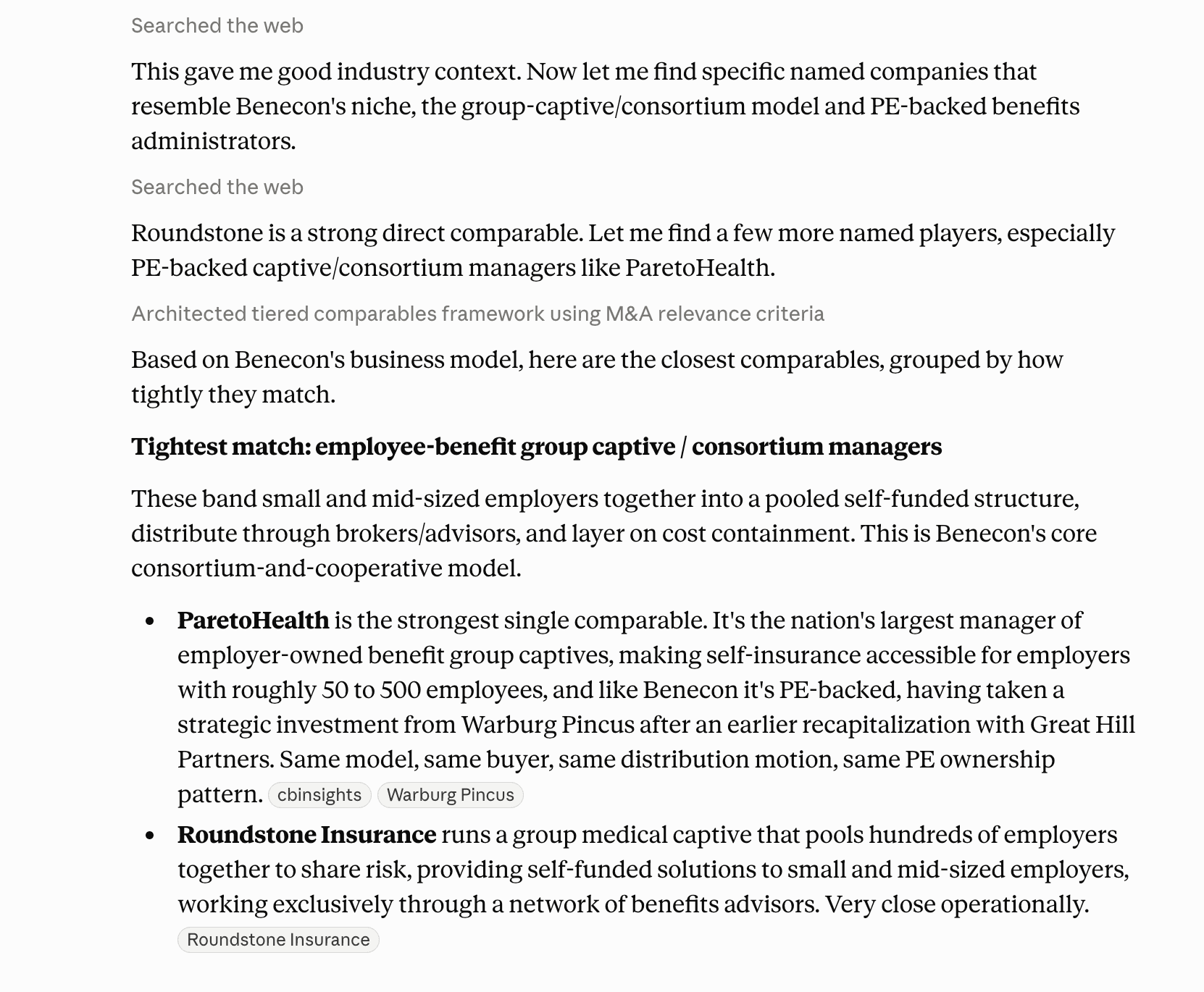
The answers are correct. They are just not yours. Nothing here is shaped by your real deal data, by your firm's own definition of a comp, or by a single deal your team has actually worked. Without a context layer, that is the ceiling: a well-reasoned read of the public record.
The obvious fix is to point it at your own data. Connect your SharePoint and CRM over MCP and ask again. But connecting your data is not the same as structuring it. MCP gives the model access to your files. It does not give it your firm's decisions. Ask over your own folders and you still get a retrieval answer, fluent and confident, and still not your firm's answer.
A firm question asks something the public record cannot hold: which of our deals does this one rhyme with, by our definition, and what did we conclude about them?
Similar Deals Look Simple. Getting It Right Isn't.
Ask for similar deals and the request sounds trivial: find the deals that look like this one. The difficulty hides inside the word “like.” Getting it right means holding three kinds of complexity at once, and they do not add up. They multiply.
Business complexity, what makes a deal “similar” at all.
“Similar” is a judgment, not a lookup. Two companies can share a subsector label and run entirely different businesses. The real drivers of whether a deal rhymes with a past one: business model, margin structure, growth mix (organic vs. acquisitive), and thesis or deal-structure type. Two businesses can sit in the same subsector and be nothing alike, and two in different subsectors can be near-twins on the traits that decide an investment.
Data complexity, the evidence is never even.
Suppose you have agreed what “similar” means. The evidence still is not evenly distributed. One deal carries a full CIM, expert calls, and an IC deck. The comparable beside it has a single CRM note and nothing more. Comparability has to survive that asymmetry: judging two deals when you know ten times more about one than the other, and knowing which of the gaps actually change the conclusion.
Technical complexity, making it hold together.
Then the machinery underneath. Resolving the same company across scattered sources into one record. Maintaining a taxonomy that reflects real business models, not coarse labels. Matching across your entire history rather than the handful of nearest names. Tracing every match back to the document behind it. Each of these is a system to build and maintain, not a setting to switch on.
These layers do not sit in neat tiers. They compound. A fuzzy business definition makes the data gaps harder to read. Thin data forces the technical matching to lean on taxonomy, which is exactly where the business nuance was already lost. Miss one layer and the other two amplify the error rather than catch it. Get all three right, and they shape what actually matters: which deals you surface, which ones you focus on, and what you know walking into the room.
How Metal Answers a Firm Question
This is what a context layer is for. Metal structures your scattered deals and the decisions behind them into one graph before you ask a single question, and it works each of the three complexities rather than any one of them.
On business nuance, Metal encodes your firm's own definition of comparable. Your industry tree and a Scoring Framework your team defines carry the model, the customers, and the value proposition, not a single sector tag. None of this waits on prior classification. Metal derives comparability from the model itself, and any relationships your team has confirmed become one more signal it compounds on.
On data, the context graph holds whatever each deal actually has. Every document, insight, and pipeline signal for a deal already lives together in its Deal Workspace, resolved onto the same deal entity. A full CIM and expert calls on one, a thin CRM note on another, and comparisons run across that uneven evidence instead of breaking on it, with every match showing what it is standing on.
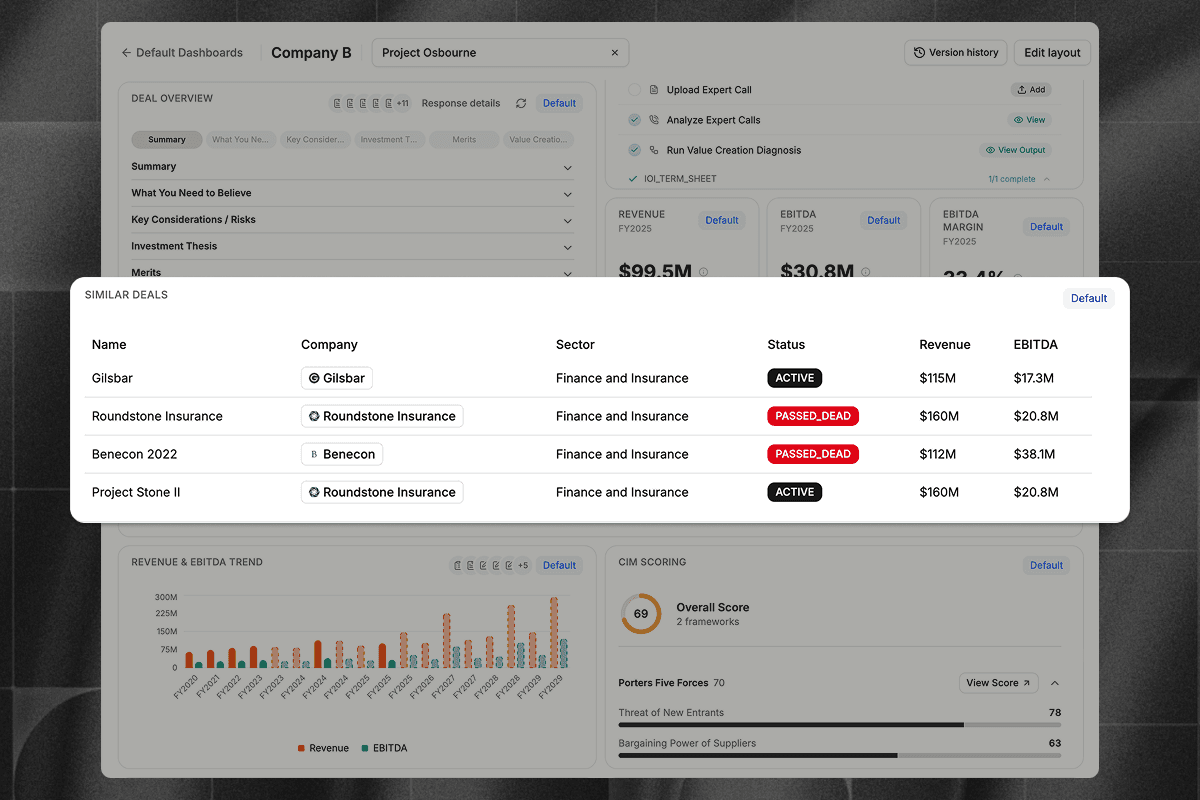
On the technical layer, entity resolution, provenance back to the source document, matching across your full history, and permissions are Metal's to build and maintain, not your team's. Because it is one graph, the three layers reinforce each other instead of compounding the error, and every deal you work feeds back so the next comparison starts sharper.
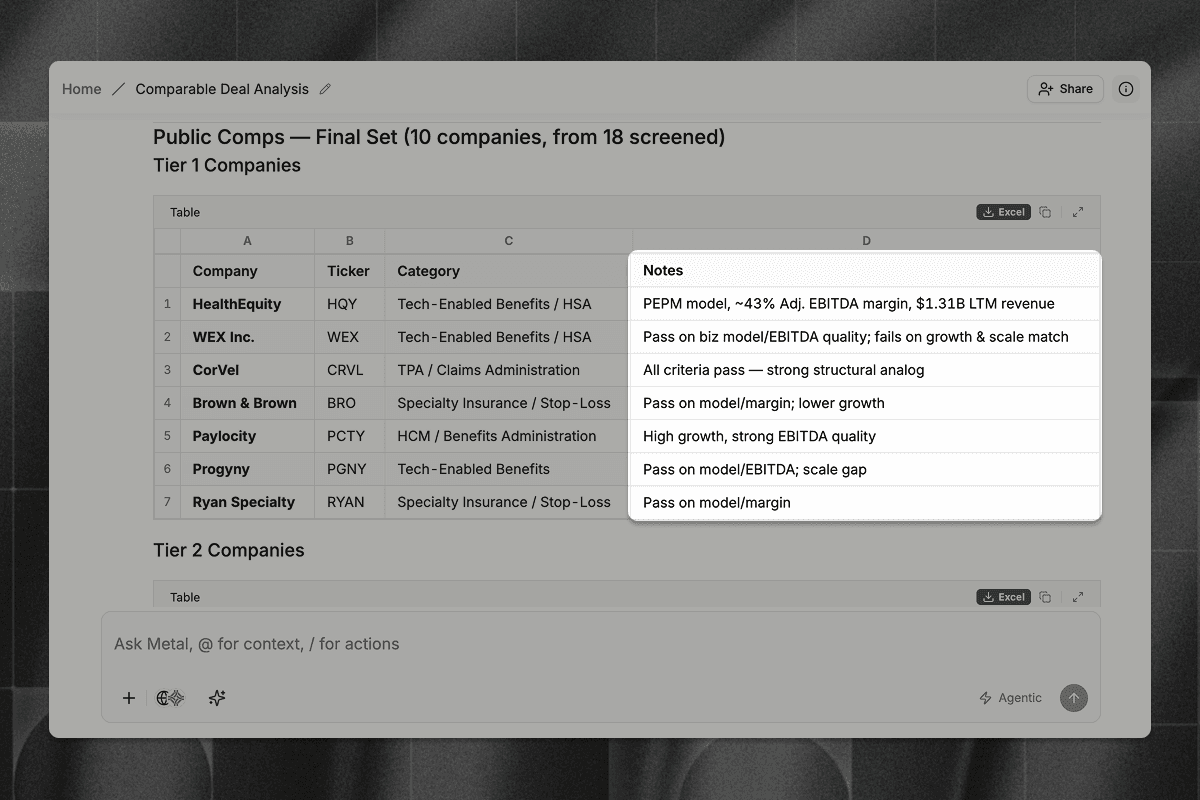
Identifying similar deals is just the first part. Once a comp is identified, the "so what" is what you really want. Everything your firm already knows about it: did you win it, pass, or exit it, what was the thesis, which risk got flagged, what happened next. The context graph stores that judgment, not just the deal data, so each comp arrives carrying the call you made and why. That is what turns a list of names into conviction, and it exists nowhere in public data.
Without a context graph, your AI cannot touch this layer at all, because the layer is not in your documents. It is in the decisions your firm made about them.
Build for the Data, Not the Pipe
The test of AI's value here is not about whether it can retrieve quickly and accurately. But whether it surfaces the comps and the reasoning so conviction is easier to reach — the comparable you would have overlooked; the risk you saw three years ago, back on the table at the moment it matters.
The instinct that something felt familiar stops sitting there unconfirmed. With the context layer, that question finally has your firm's answer, not a guess.
See Similar Deals on your own data. Book a demo.